


2020.11.19 CoStone Capital Views:
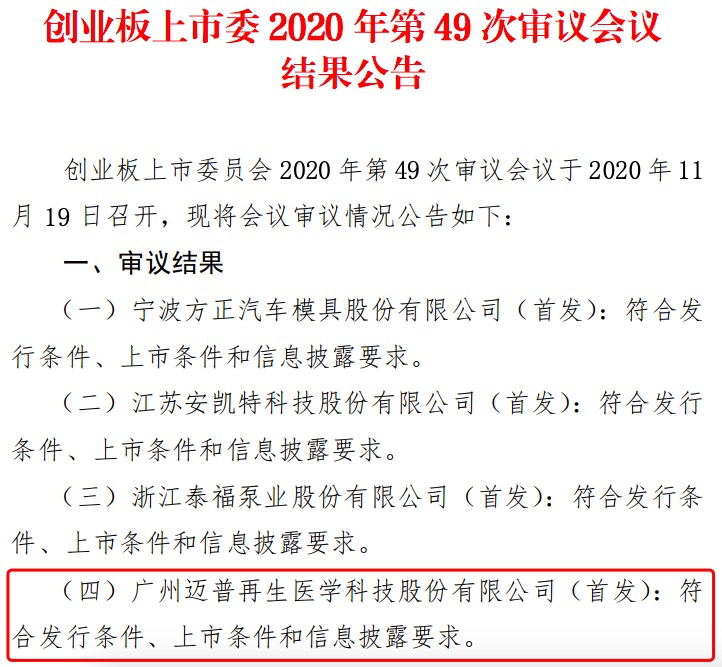
On November 19, the IPO application of MEDPRIN(ipo 108577), one of CoStone Capital’s investment project, was approved by GEM Listing Committee. With Anhui Huaheng Biotechnology(831088) passed CSRC approval on November 17, CoStone has two companies launching IPO this week.

Founded in September 2008, Medprin Regenerative Medical Technologies Co., Ltd. is a high&new technology enterprise dedicated to developing advanced implantable medical devices using cutting-edge manufacturing technology based on the characteristics of synthetic material.
As of the prospectus is signed, Medprin has acquired the approved registration of 3 Class III and 1 Class II medical devices, set up file for 1 Class I medical device product, and obtained CE and CE Design certificates for 3 products. Its absorbable hemostatic yarn is pending for domestic registration approval, and its absorbable medical glue and absorbable oral repair film are in clinical trials. Medprin’s business scope covers many departments such as neurosurgery and stomatology, and it has also established a global marketing system. As of March 31, 2020, Medprin has established cooperation with more than 400 distributors at home and abroad, and its products have been used by more than 600 domestic hospitals. Medprin’s international market covers more than 70 countries and regions including Europe, South America, Asia, and Africa with more than 200,000 clinical cases.
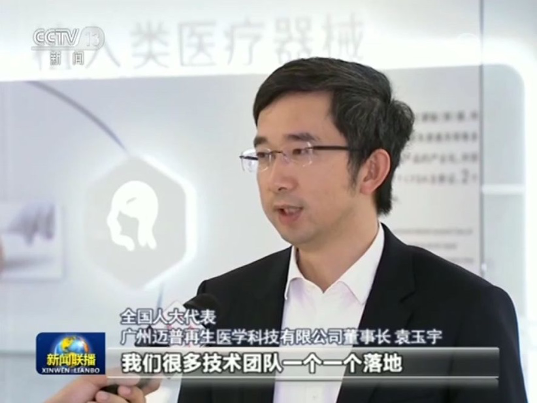
Yuan Yuyu, Founder of Medprin, being interviewed by CCTV
Fortune Magzine editor in chief, Clifton Leaf visited Medprin and wrote an article, in which he said: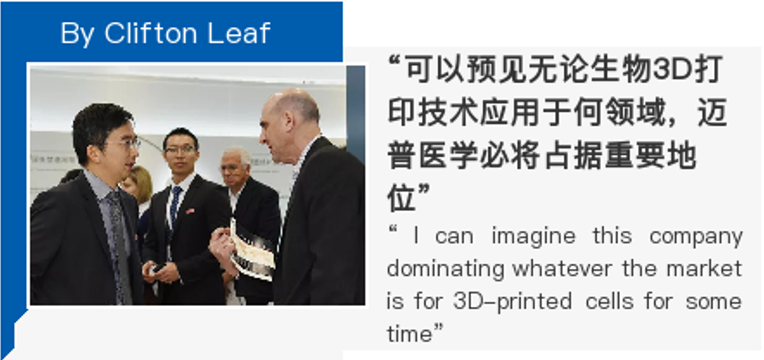
Vision of Medprin
Yuan Yuyu, founder of Medprin, said that in the future, innovative SMEs has a promising market potential in fields like personalized precision medicine and personalized reconstructions of human tissues and organs.
“We are trying to become the Johnson & Johnson of China.” According to Yuan, 3D Bioprinter is a technology that laid the foundation for Medprin. Starting from there, Medprin aspires to extend its business to a larger market of medical equipment.
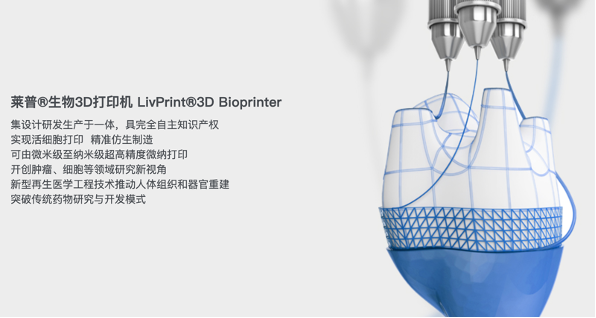
LivPrint 3D Bioprinter independently developed by Medprin
Ushering in a new chapter
On November 19, 2020, the IPO application of Medprin(ipo 108577) was approved by GEM Listing Committee, giving its investor, CoStone, the second listed company this week after Anhui Huaheng Biotechnology(831088).
According to CoStone, Medprin has started from neurosurgery and made innovative exploration to industrialize the 3D Bioprinting technology. The company has a professional, efficient and visionary team, and it has been aiming for the global market since the designing of its first competitive product, ReDura. In the future, the company plans to extend business into personalized craniofacial jaw repairing and tension-free incontinence slings. Medprin will continue to “print life”, and further commit itself to personalized reconstruction of tissues and organs.
Rewritten by Xue Guanda, Edited by Du Zhixin, Wei Yiyi
Over the past year, the bull market returned, with technology leading the way.
As I said back in October 2024, the rally that began on September 24 was not merely a rebound, but a reversal. Since then, China's capital markets have undergone a broad revaluation, moving from undervaluation toward fair value.
The Shanghai Composite Index reached its highest level in a decade. The "Yi-Zhong-Tian" trio—Eoptolink, Zhongji Innolight and TFC Communication, three prominent Chinese optical communications stocks—saw their share prices multiply severalfold in a single year. Cambricon's market capitalization briefly exceeded RMB 600 billion. Elsewhere in the technology sector, triple-digit price-to-earnings ratios and valuations exceeding RMB 10 billion became commonplace.
Some investors were greedy; others, fearful. Still others asked me: Are technology stocks in a valuation bubble?
My answer is that what we are witnessing is the hunger and anxiety of an era, reflected in the capital markets. Once you understand this, the current fervor for technology investing is no longer difficult to explain.
Investment has nothing to do with macroeconomics, but everything to do with geopolitics.
China-US relations will shape the investment landscape for decades to come. Geopolitics has played a major role in shaping the hunger and anxiety of our times, fundamentally reshaping the way we invest.
What, then, lies at the heart of China's hunger and anxiety?
The Fourth Industrial Revolution is already underway, yet China has not fully overcome the technological shortcomings left by the Third. There is no time to lose.
This is why some people wonder: Why do Chinese computing chip companies command such high valuations when their technologies still lag so far behind NVIDIA's? Why does NVIDIA trade at just 50 times earnings, while a company hailed as "China's answer to NVIDIA" commands a multiple of 300?
To me, this gets the logic exactly backward.
It is precisely because these companies cannot catch up with NVIDIA in the near term that they command a higher strategic premium. The wider the technological gap, the greater the strategic value.
The further something lies beyond our reach, the stronger our hunger. The harder it is to catch up, the deeper our anxiety. If China were to achieve a complete breakthrough in computing chips one day, valuations might actually come down.
Where can one find China's most spectacular natural landscapes?
Much of the answer, I believe, lies in and around the Hengduan Mountains: the Meili Snow Mountains, Jade Dragon Snow Mountain, Mount Gongga, Mount Siguniang, Jiuzhaigou, and many others. Vast differences in elevation and deep fault lines have given rise to landscapes of extraordinary grandeur.
Hard-tech investing follows a similar logic.
Technological gaps, discontinuities in capabilities, and missing links in industrial systems: a leap in difficulty brings a leap in valuation, and a successful breakthrough can, in turn, bring a leap in returns.
This logic extends well beyond computing chips. It is equally evident in memory semiconductors, commercial spaceflight, and other sectors where China still faces substantial technological gaps with other countries.
It was precisely this conviction that led CoStone Capital, starting in 2016, to decisively focus its investments on three areas: hard tech, emerging industries, and life sciences and healthcare. In this context, "hard tech" refers specifically to important industries in which China faces a technological gap with the United States.
Thanks to this forward-looking strategy, CoStone Capital established an early presence across the full value chains of key sectors, including semiconductors, artificial intelligence, and robotics.
Looking ahead, the frontiers of technological progress and industrial upgrading are boundless. Nor can the gaps in hard technology be closed overnight. The twin windows of opportunity presented by technological innovation and the development of homegrown alternatives to foreign technologies have only just begun to open.
The road ahead is long, but the future holds immense promise.
As an investment firm, CoStone Capital will continue to invest where the hunger and anxiety of each era run deepest, move forward with the tensions that shape our times, and extend our reach toward the most challenging—and most important—frontiers.
Spring 2026