

.png)
2014.05.15
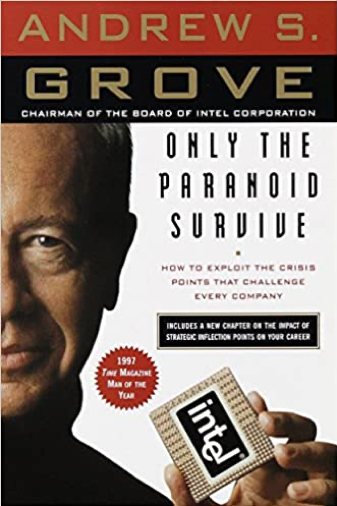
Only the Paranoid Survive is a masterpiece of modern leadership. Andrew Grove, founder and former CEO of Intel, underscores his message by sharing his own record of success and failure. He expounds his strategies on how to find a turning point and cope with both opportunities and challenges in the face of the complicated and capricious market, as leaders in a company.

Big Data is the first major book to explain the earthshaking subject, how it will change our lives and what we can do to protect ourselves from its hazards. Big data will create an unprecedented realm for people’s life. It inspires inventions and new services. More changes are on the horizon. Viktor points out that what the times of big data strikes, people should be aware of “what” instead of asking “why”. This notion overturns the traditional way of thinking and poses new challenges for human communications.

The Explosion Chronicles, a Booker International Prize winner, is a tongue-in-cheek guide to the growth of one of China’s biggest cities, showing how a small hamlet has become a shining example of the recent rapid Chinese economic growth. It depicts a story of families, lust and money. From a little hamlet to a metropolis, people of that times experienced lust in transformation, agony in humanity, love and hatred among families and kindness from the world.

Shen Haobo, the representative of Lower Body Poems, poured all his affection in this collection of poems which he wrote from 1999 to 2012. Five chapters reveals five perspectives of his emotions. The first chapter, “Let Me Hold You Tight”, concludes 30 poems on love and family ties. While in the third chapter and the forth chapter, he brings his emotion to another level and criticizes the issues of the times. He believes poems will never fade away even when those who write them pass away.

The illustrated World’s Religions retains all the beloved qualities of Huston Smith’s classics. Instead of telling history, this book centers on the value of religions that features noble life goals, in-depth life experience and strong power. Such a value encourages people to be more perfect. This stunning guide of religions presents readers detailed, absorbing and richly illustrated chapters on Hinduism, Buddhism, Confucianism, Christianity, Taoism and other religions. Readers can find it enjoyable to get into the differences and similarities among the worldwide religious traditions.

Karen Armstrong can take 4,000 years of God and human interaction and reduce it to the fundamentals without oversimplifying. Her writing is light, but is full of clues, prominent characters and thrilling plots. The intact and comprehensive picture of the history of God can be illuminating for those who are seeking God. It is an unparalleled masterpiece of religions. Readers can enjoy rich knowledge and detailed explanations on religions. It can act like a reliable guide, story of history and inspiration.
Rewritten by: Luo Xinying, Edited by: Du Zhixin, Wei Yiyi
Over the past year, the bull market returned, with technology leading the way.
As I said back in October 2024, the rally that began on September 24 was not merely a rebound, but a reversal. Since then, China's capital markets have undergone a broad revaluation, moving from undervaluation toward fair value.
The Shanghai Composite Index reached its highest level in a decade. The "Yi-Zhong-Tian" trio—Eoptolink, Zhongji Innolight and TFC Communication, three prominent Chinese optical communications stocks—saw their share prices multiply severalfold in a single year. Cambricon's market capitalization briefly exceeded RMB 600 billion. Elsewhere in the technology sector, triple-digit price-to-earnings ratios and valuations exceeding RMB 10 billion became commonplace.
Some investors were greedy; others, fearful. Still others asked me: Are technology stocks in a valuation bubble?
My answer is that what we are witnessing is the hunger and anxiety of an era, reflected in the capital markets. Once you understand this, the current fervor for technology investing is no longer difficult to explain.
Investment has nothing to do with macroeconomics, but everything to do with geopolitics.
China-US relations will shape the investment landscape for decades to come. Geopolitics has played a major role in shaping the hunger and anxiety of our times, fundamentally reshaping the way we invest.
What, then, lies at the heart of China's hunger and anxiety?
The Fourth Industrial Revolution is already underway, yet China has not fully overcome the technological shortcomings left by the Third. There is no time to lose.
This is why some people wonder: Why do Chinese computing chip companies command such high valuations when their technologies still lag so far behind NVIDIA's? Why does NVIDIA trade at just 50 times earnings, while a company hailed as "China's answer to NVIDIA" commands a multiple of 300?
To me, this gets the logic exactly backward.
It is precisely because these companies cannot catch up with NVIDIA in the near term that they command a higher strategic premium. The wider the technological gap, the greater the strategic value.
The further something lies beyond our reach, the stronger our hunger. The harder it is to catch up, the deeper our anxiety. If China were to achieve a complete breakthrough in computing chips one day, valuations might actually come down.
Where can one find China's most spectacular natural landscapes?
Much of the answer, I believe, lies in and around the Hengduan Mountains: the Meili Snow Mountains, Jade Dragon Snow Mountain, Mount Gongga, Mount Siguniang, Jiuzhaigou, and many others. Vast differences in elevation and deep fault lines have given rise to landscapes of extraordinary grandeur.
Hard-tech investing follows a similar logic.
Technological gaps, discontinuities in capabilities, and missing links in industrial systems: a leap in difficulty brings a leap in valuation, and a successful breakthrough can, in turn, bring a leap in returns.
This logic extends well beyond computing chips. It is equally evident in memory semiconductors, commercial spaceflight, and other sectors where China still faces substantial technological gaps with other countries.
It was precisely this conviction that led CoStone Capital, starting in 2016, to decisively focus its investments on three areas: hard tech, emerging industries, and life sciences and healthcare. In this context, "hard tech" refers specifically to important industries in which China faces a technological gap with the United States.
Thanks to this forward-looking strategy, CoStone Capital established an early presence across the full value chains of key sectors, including semiconductors, artificial intelligence, and robotics.
Looking ahead, the frontiers of technological progress and industrial upgrading are boundless. Nor can the gaps in hard technology be closed overnight. The twin windows of opportunity presented by technological innovation and the development of homegrown alternatives to foreign technologies have only just begun to open.
The road ahead is long, but the future holds immense promise.
As an investment firm, CoStone Capital will continue to invest where the hunger and anxiety of each era run deepest, move forward with the tensions that shape our times, and extend our reach toward the most challenging—and most important—frontiers.
Spring 2026