

.png)
2016.12.29
Reading and travelling can enrich our lives and rejoice ourselves. Genes and environment affect the fate of most people. The last generation lived in the turbulent and chaotic era when people drifted all their lives and still were grateful to be alive. They suffered from anti-fascist war, civil war, three years of grave natural disasters which took away tens of millions of lives and cultural revolution. Waves of suffering overwhelmed people at that times. One needed enormous luck and power to escape from these man-made or natural disasters. The chaotic times and environment make people unable to read and travel. When our basic needs are met and no one should work around the clock to make ends meet, reading and travelling can enrich our lives and become a better person. They do not take much, but they can flourish our minds and enlighten our lives.
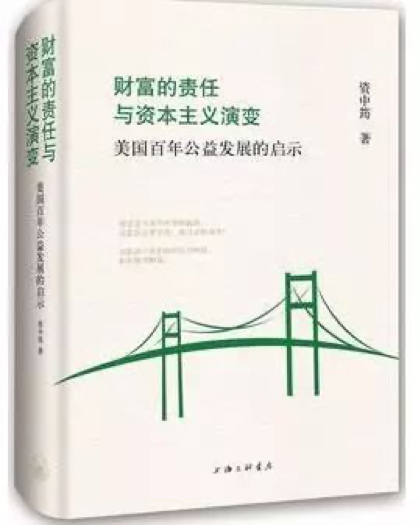
The Responsibility of Wealth and Evolution of Capitalism is an informative guide to American philanthropy. Zi Zhongjan posts an inspiring question that how the capital can be generated to do something good. He endured years of hardship to find a way to utilize capital to benefit the world. In line with Zi Zhongjun, CoStone believes that funds should be invested in inventions and innovations and should support enterprises. When the enterprises are fully grown, they are able to join philanthropy. CoStone joins hands with OPPLE to promote traditional Chinese culture through Lianbang Charity Group. We build up a philanthropic system ourselves instead of donating money, thanks to the wisdom and the kindness of our customers and employees.
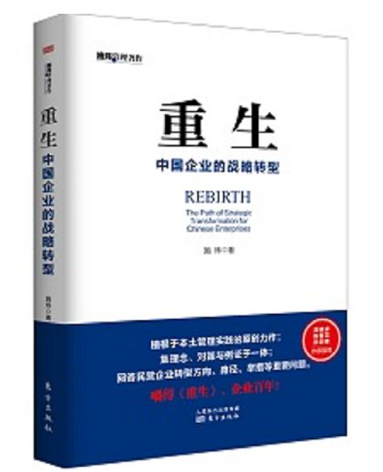
Shi Wei, an excellent consultant in chief of China Stone and scholar of practical management. Written in lucid and logic words, Rebirth concludes Shi Wei’s insights on the transformation of Chinese enterprises. He believes that corporate culture is the basis of growth. The culture embedded in an enterprise refers to the designs of leadership and social values. At present, Chinese enterprises are suffering from tremendous anxiety and struggling to survive. Only when enterprises remain true to their goals and abide by their values can they walk out of the darkest hours.
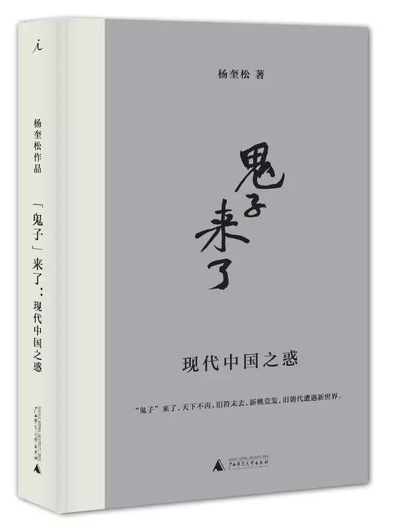
Yang Guisong is a world-class and world-renowned expert on China’s modern history and the history of the Communist Party of China. He makes all knowledge about modern China his province, and in Foreign Invasion is to be found more worldly wisdom and commonsense than in any other book. One can understand the history well through his lucid essays in this book. The presence of a worldly-wise and supremely rational mind can bring the beauty of history to readers.
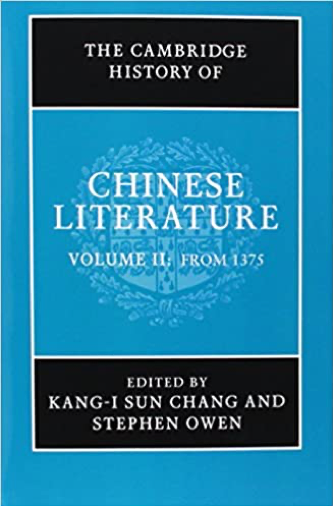
The Cambridge History of Chinese Literature is edited by famous scholars, Kang-I Sun and Stephen Owen, which represents the highest level of studies on China in the West. The History offers both an integrated narrative, situating literature in its larger cultural context, and an overview of the key developments of Chinese literature in the past millennia accessible to non-specialist readers as well as scholars and students of Chinese.
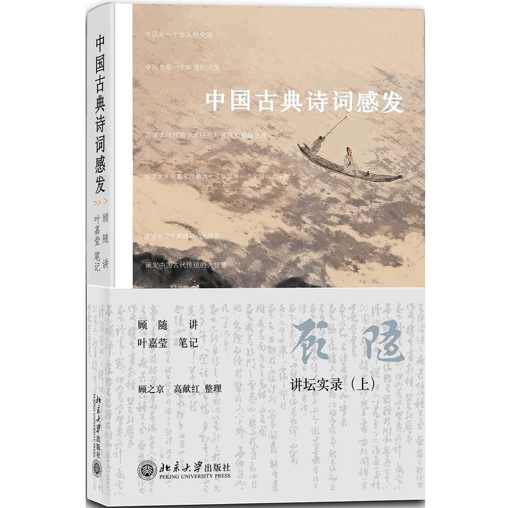
Ye Jiaying is the student of Gu Sui in Fu Jen Catholic University as well as the greatest master of Chinese literature in 20th century. This book records the key points of Gui Sui’s lectures. Gu Sui combines Chinese culture with western cultures and offers insights on lives and society. The integration of culture, literature and art enables readers to travel the cosmos of Classical Chinese poetry.

Written in poetic and lucid words, Fengjing Jiu Cheng’an is one of the classics of Ye Jiaying, an outstanding scholar and advocate of classical Chinese culture. Never a writer can use such plain and lucid words to explain such complicated notions in traditional culture. She is still a keen lecturer even at her nineties. She expounds exposition, comparison and affective image, three profound techniques of Chinese poetry, with plain but worldly-wise words. This book displays a diversified world hidden in the poems of famous poets. The beauty in it gushes out as the reader starts to read.
Rewritten by: Luo Xinying, Edited by: Du Zhixin, Wei Yiyi
Over the past year, the bull market returned, with technology leading the way.
As I said back in October 2024, the rally that began on September 24 was not merely a rebound, but a reversal. Since then, China's capital markets have undergone a broad revaluation, moving from undervaluation toward fair value.
The Shanghai Composite Index reached its highest level in a decade. The "Yi-Zhong-Tian" trio—Eoptolink, Zhongji Innolight and TFC Communication, three prominent Chinese optical communications stocks—saw their share prices multiply severalfold in a single year. Cambricon's market capitalization briefly exceeded RMB 600 billion. Elsewhere in the technology sector, triple-digit price-to-earnings ratios and valuations exceeding RMB 10 billion became commonplace.
Some investors were greedy; others, fearful. Still others asked me: Are technology stocks in a valuation bubble?
My answer is that what we are witnessing is the hunger and anxiety of an era, reflected in the capital markets. Once you understand this, the current fervor for technology investing is no longer difficult to explain.
Investment has nothing to do with macroeconomics, but everything to do with geopolitics.
China-US relations will shape the investment landscape for decades to come. Geopolitics has played a major role in shaping the hunger and anxiety of our times, fundamentally reshaping the way we invest.
What, then, lies at the heart of China's hunger and anxiety?
The Fourth Industrial Revolution is already underway, yet China has not fully overcome the technological shortcomings left by the Third. There is no time to lose.
This is why some people wonder: Why do Chinese computing chip companies command such high valuations when their technologies still lag so far behind NVIDIA's? Why does NVIDIA trade at just 50 times earnings, while a company hailed as "China's answer to NVIDIA" commands a multiple of 300?
To me, this gets the logic exactly backward.
It is precisely because these companies cannot catch up with NVIDIA in the near term that they command a higher strategic premium. The wider the technological gap, the greater the strategic value.
The further something lies beyond our reach, the stronger our hunger. The harder it is to catch up, the deeper our anxiety. If China were to achieve a complete breakthrough in computing chips one day, valuations might actually come down.
Where can one find China's most spectacular natural landscapes?
Much of the answer, I believe, lies in and around the Hengduan Mountains: the Meili Snow Mountains, Jade Dragon Snow Mountain, Mount Gongga, Mount Siguniang, Jiuzhaigou, and many others. Vast differences in elevation and deep fault lines have given rise to landscapes of extraordinary grandeur.
Hard-tech investing follows a similar logic.
Technological gaps, discontinuities in capabilities, and missing links in industrial systems: a leap in difficulty brings a leap in valuation, and a successful breakthrough can, in turn, bring a leap in returns.
This logic extends well beyond computing chips. It is equally evident in memory semiconductors, commercial spaceflight, and other sectors where China still faces substantial technological gaps with other countries.
It was precisely this conviction that led CoStone Capital, starting in 2016, to decisively focus its investments on three areas: hard tech, emerging industries, and life sciences and healthcare. In this context, "hard tech" refers specifically to important industries in which China faces a technological gap with the United States.
Thanks to this forward-looking strategy, CoStone Capital established an early presence across the full value chains of key sectors, including semiconductors, artificial intelligence, and robotics.
Looking ahead, the frontiers of technological progress and industrial upgrading are boundless. Nor can the gaps in hard technology be closed overnight. The twin windows of opportunity presented by technological innovation and the development of homegrown alternatives to foreign technologies have only just begun to open.
The road ahead is long, but the future holds immense promise.
As an investment firm, CoStone Capital will continue to invest where the hunger and anxiety of each era run deepest, move forward with the tensions that shape our times, and extend our reach toward the most challenging—and most important—frontiers.
Spring 2026